How to Break In Work Boots Without Blisters
As an Amazon Associate, BetterPick Hub earns from qualifying purchases on Amazon.ca.
As an Amazon Associate, BetterPick Hub earns from qualifying purchases. Our picks are based on manufacturer specifications and buyer review patterns, not hands-on testing.
This guide is for Canadian workers who just bought new work boots, or are about to, and want to get through the first weeks without raw heels and sore toes.
The short answer: blisters during break-in usually come down to fit, friction and doing too much too soon. Start with a boot that fits properly, wear it for short stretches before a full shift, and wear cushioned socks while the boot settles in. If you would rather skip most of the break-in, some boots are sold with the claim that they need none.
Quick Picks
- If you need a waterproof 6-inch CSA boot that the maker says needs no break-in: Red Wing Apex #3574
- If you need a lighter, athletic-style CSA safety shoe for warehouse or light manufacturing work: Red Wing ShieldLite Athletics #3297
- If you need a cushioned work sock for break-in and every shift after: Darn Tough Men’s Steely Boot Midweight Work Sock (2006)
- If you need more cushioning in a roomy work boot for long hours standing: Superfeet Work Cushion Insoles
- Who should not buy any of these: if your boots already pinch your toes or let your heel lift when laced, no sock, insole or break-in routine will fix that. The Canadian Centre for Occupational Health and Safety (CCOHS) says not to expect footwear to stretch with wear, so return or exchange boots that do not fit before you start breaking them in.
Start Here: Make Sure the Boot Actually Fits
Break-in can soften a boot. It cannot fix the wrong size. CCOHS gives clear fitting advice for safety footwear:
- Try boots on around midday. CCOHS notes that feet normally swell during the day.
- Walk in them. CCOHS says to walk in new footwear to make sure it is comfortable.
- Leave toe room. Toes should be about 12.5 mm from the front of the boot, according to CCOHS.
- Do not count on stretch. CCOHS says plainly: do not expect footwear to stretch with wear.
- Bring your work socks and insoles. CCOHS advises making allowances for extra socks or special arch supports when buying boots, and trying new boots on with the supports or socks you usually wear at work.
- Check the heel and ankle. Boots should fit snugly around the heel and ankle when laced, and CCOHS says to lace boots up fully.
Quick Takeaway: A heel that slides up and down rubs. Toes that touch the front get pressed. Both are fit problems, not break-in problems, and CCOHS’s guidance is that the boot will not stretch to fix them.
If you are still choosing a boot, our Canadian work boots guide explains the main CSA features to compare first.
A Gradual Break-In Plan
Red Wing’s European break-in tips say these steps are not mandatory, but that they can help make the break-in period more pleasant and shorter. Here is a plan built around that advice and the CCOHS fit guidance.
Step 1: Wear them at home first. Red Wing advises not going straight into all-day wear. Begin by wearing your boots indoors for a few hours at a time. Red Wing explains that the leather needs time to soften and mold to your feet, and your feet need time to adjust to the boots.
Step 2: Build up gradually. After the first few short sessions, Red Wing’s advice is to gradually build up. A practical approach is to wear the new boots for part of a shift and keep your old pair nearby to change into.
Step 3: Wear padded socks. Red Wing calls this an underrated tip: padded socks dramatically reduce friction and cushion your feet while the leather is still breaking in. Use the same socks you plan to wear on the job, since CCOHS says to try boots on with the socks you usually wear at work.
Step 4: Lace them properly. Follow CCOHS: lace up fully, with the boot snug around the heel and ankle.
Step 5: Give them a day off. Red Wing advises that after a few days of consecutive wear, you give your boots at least a full day off, because leather needs time to breathe and dry out completely.
Step 6: Watch for hot spots. If you feel a spot starting to rub, stop and check the fit, lacing and socks before carrying on.
If you are adding an insole, break that in too. Superfeet says its insoles may require a break-in period of about two weeks. Its plan for the first week is 1 to 2 hours on the first day, 2 to 3 hours on the second day, then gradually increasing each day until your feet are used to wearing the insoles all day.
Comparison Table
| Product | Type | Toe / rating (as listed) | Height | Weight (as listed) | Widths | Waterproofing | Break-in note from maker |
|---|---|---|---|---|---|---|---|
| Red Wing Apex #3574 | Boot | Aluminum toe; CSA Grade 1, ESR Rated, PR | 6-inch | 4 lbs. 8 oz. | D, EE, H | Red Wing Waterproofing | “No break-in period” |
| Red Wing ShieldLite Athletics #3297 | Athletic safety hiker | Non-metallic toe; CSA Grade 1, ESR Rated, PR | 5-inch hiker | 2 lbs. 15 oz. | Not listed | Not listed | “No break-in period” |
| Darn Tough Steely Boot Midweight (2006) | Sock | Not applicable | Boot height, about 11 in. heel to cuff | Midweight | Not applicable | Not applicable | Not listed |
| Superfeet Work Cushion | Insole | Not applicable | Not applicable | Not listed | Trim-to-fit | Not applicable | Insole break-in of about two weeks |
Quick Terms: CSA Grade 1 refers to the toe cap grade. The Red Wing pages do not say which CSA triangle marking these boots carry, so check the triangle label on the boot itself. PR on the Red Wing pages stands for puncture resistant. ESR is listed by Red Wing as “ESR Rated”; CCOHS warns that electric shock resistance is greatly reduced by wet conditions and wear. Your site’s electrical safety rules decide what footwear you need. Always check the labels on the boot itself.
For more on how toe cap materials compare, see our steel toe vs composite toe guide.
Red Wing Apex #3574: Waterproof Boot With No Listed Break-In
Who it suits: workers who want a 6-inch waterproof CSA boot and would rather not spend weeks breaking it in. Red Wing describes the Apex as great for construction, warehousing and other active trades.
Specs that matter for break-in:
- No break-in period, per the maker. Red Wing says the Apex “offers lightweight durability, flexibility, and no break-in period.”
- Padded collar and tongue. Red Wing says the waterproof nubuck upper has a padded collar and tongue for extra comfort.
- Three width options. The page offers D, Wide (EE) and Wide (H). Since CCOHS says not to expect footwear to stretch, it makes sense to pick the width that fits from the start.
- Cement construction with an EVA footbed and a TPU shank.
Protection and weather: an aluminum safety toe, listed as CSA Grade 1, ESR Rated, PR, with ASTM F2413-24, I/C, EH PR SRO. The puncture-resistant insole is a Lenzi PS5ES. Red Wing Waterproofing uses a moisture-deterrent lining, cushioning foam and a waterproof bootie barrier. The Vibram ReGrip DLT outsole is made with recycled rubber, and Red Wing says the soles resist melting at a minimum of 475°F.
Things to know: Red Wing lists the weight as 4 lbs. 8 oz., the heavier of the two boots here, and says it is not resoleable.
What buyers say: we could not find readable buyer reviews for this model on the manufacturer page, so we have not summarized any.
Red Wing ShieldLite Athletics #3297: Athletic-Style CSA Safety Hiker
Who it suits: warehouse and light manufacturing workers who want something closer to a training shoe than a traditional leather boot. Red Wing says it is ideal for warehousing and light manufacturing.
Specs that matter for break-in:
- No break-in period, per the maker. Red Wing lists “No break-in period” under its comfort features.
- Light for a safety shoe. The listed weight is 2 lbs. 15 oz., the lightest of the two boots here.
- Flexible build. Red Wing describes it as flexible and lightweight, with direct attach (cement) construction, strategic support and high-rebound cushioning.
- Removable footbed. The polyurethane footbed is removable. If you plan to add an aftermarket insole, CCOHS advises checking with the manufacturer whether adding inserts affects your level of protection.
Protection: a non-metallic safety toe, listed as CSA Grade 1, ESR Rated, PR, with ASTM F2413-18, M/I/C, EH PR and ASTM F3445-21, SR. The puncture-resistant insole is a Lenzi Q FLEX TX T6. Red Wing says its Perspair technology offers cut resistance and moves moisture away from the foot.
Things to know: it is a 5-inch hiker style, so it sits lower than a 6-inch boot. Red Wing does not list widths or waterproofing for this model, and it is not resoleable.
What buyers say: we could not find readable buyer reviews for this model on the manufacturer page, so we have not summarized any.
Darn Tough Steely Boot Midweight Work Sock (2006): Cushion for the Break-In Weeks
Who it suits: anyone breaking in new boots who wants a cushioned sock to reduce friction, following Red Wing’s advice to wear padded socks during break-in.
Specs that matter:
- Full cushion. Darn Tough says these work socks have soft terry loops underfoot and around the leg, plus a fully cushioned toe box to pair with steel toe boots.
- Fit. Darn Tough says its performance fit means no slipping and no bunching.
- Seamless toe and Achilles cushion. Toe seams are closed with True Seamless Toe technology, and there is a reinforced Achilles cushion.
- Material. 56% merino wool, 41% nylon and 3% elastane. Darn Tough says merino wool moves moisture away from the feet.
- Height. Men’s boot socks average 11 inches from heel to cuff, and Darn Tough says to expect them to rise to about the top of an 8-inch work boot.
- Lifetime guarantee. Darn Tough offers an unconditional lifetime guarantee.
Things to know: this is a full-cushion midweight sock, so it adds some thickness. Following CCOHS, try your boots on while wearing it so the fit you buy is the fit you work in.
What buyers say: the sock is rated 4.86 out of 5 from 1,093 reviews on the Darn Tough page. The review summary says buyers praise its comfort, durability and fit, appreciate the full cushioning for keeping feet dry and comfortable all day, and note the quality and warranty.
Superfeet Work Cushion Insoles: Extra Cushioning for Roomy Boots
Who it suits: workers who stand or walk for long hours and have enough room in their boots for a thick insole. Superfeet lists it for work and standing or walking long hours, and says it fits best in work boots, roomy work shoes and safety toe footwear.
Specs that matter:
- Max thickness, soft cushion. Superfeet lists the thickness as Max and the cushion as Soft, with an arch height listed as All.
- Shaped for safety toes. It has a tapered forefoot to improve fit in safety toe boots.
- Replaces your liner. Superfeet says it replaces the removable liner in roomy work footwear.
- Trim to fit. If you are between sizes or unsure, Superfeet recommends sizing half a size up, then trimming with household scissors and leaving a 1 to 2 mm gap between the insole and the end of the shoe.
- Top cover. The Moisturewick top cover is made from 100% recycled material.
Things to know: the insole has its own break-in of about two weeks, according to Superfeet, so do not start a new boot and a new insole on a full shift at the same time. Superfeet also recommends wearing socks to absorb moisture, reduce friction and extend insole life. Because it is a thick insole, it can change how your boot fits, so recheck toe room and heel hold after you put it in.
What buyers say: the insole is rated 4.55 out of 5 from 316 reviews on the Superfeet page. Buyers praise the cushioning, fit, arch support for standing all day and odour reduction. Individual complaints on the page include heel cushioning that one reviewer found barely sufficient, a changed shoe fit that caused one reviewer heel blisters until their feet adjusted, and left and right insoles that one reviewer said sat differently after trimming.
Choosing What to Buy: Matching Boots, Socks and Insoles
Sizing first. Use the CCOHS fit checks above with your work socks and any insoles you plan to use. If the Red Wing Apex feels tight across the foot, the page offers EE and H widths. Red Wing does not list widths for the ShieldLite Athletics.
Plan the break-in around the boot type. Both Red Wing boots here are listed by the maker with no break-in period. Even so, CCOHS advises walking in new footwear to make sure it is comfortable, so a short trial at home before a full shift is still a sensible step. A traditional leather boot without that claim is where Red Wing’s start-slow and day-off advice matters most.
Do not stack changes. A new boot, a new thick insole and a new sock all change the fit. If you add the Superfeet insole, Superfeet’s guidance is about two weeks of gradual wear for the insole itself, so it can help to get used to one change at a time.
Match the boot to the job. The Apex is waterproof and Red Wing describes it for construction, warehousing and other active trades. The ShieldLite Athletics is described for warehousing and light manufacturing, with no waterproofing listed. Check your site’s required CSA markings before you buy.
Keep an eye on wear. CCOHS advises inspecting footwear regularly for damage, such as cracks in soles, breaks in leather or exposed toe caps, and repairing or replacing worn or defective footwear.
If you are deciding between laces and a pull-on style, our lace-up vs slip-on safety boots comparison covers how each style holds the heel and ankle.
Who Should Buy What
- You want a waterproof 6-inch CSA boot with a listed no-break-in claim and width options: Red Wing Apex #3574.
- You work in a warehouse or light manufacturing and want a lighter athletic-style CSA safety shoe: Red Wing ShieldLite Athletics #3297.
- You are breaking in any new boot and want a cushioned work sock: Darn Tough Steely Boot Midweight Work Sock (2006).
- You stand for long hours and your boots have room for a thick insole: Superfeet Work Cushion Insoles, broken in gradually.
- Your current boots pinch or let your heel slip: none of these will fix it. Exchange them for a better fit first.
Sources & Technical References
Related Safety Boots Guides
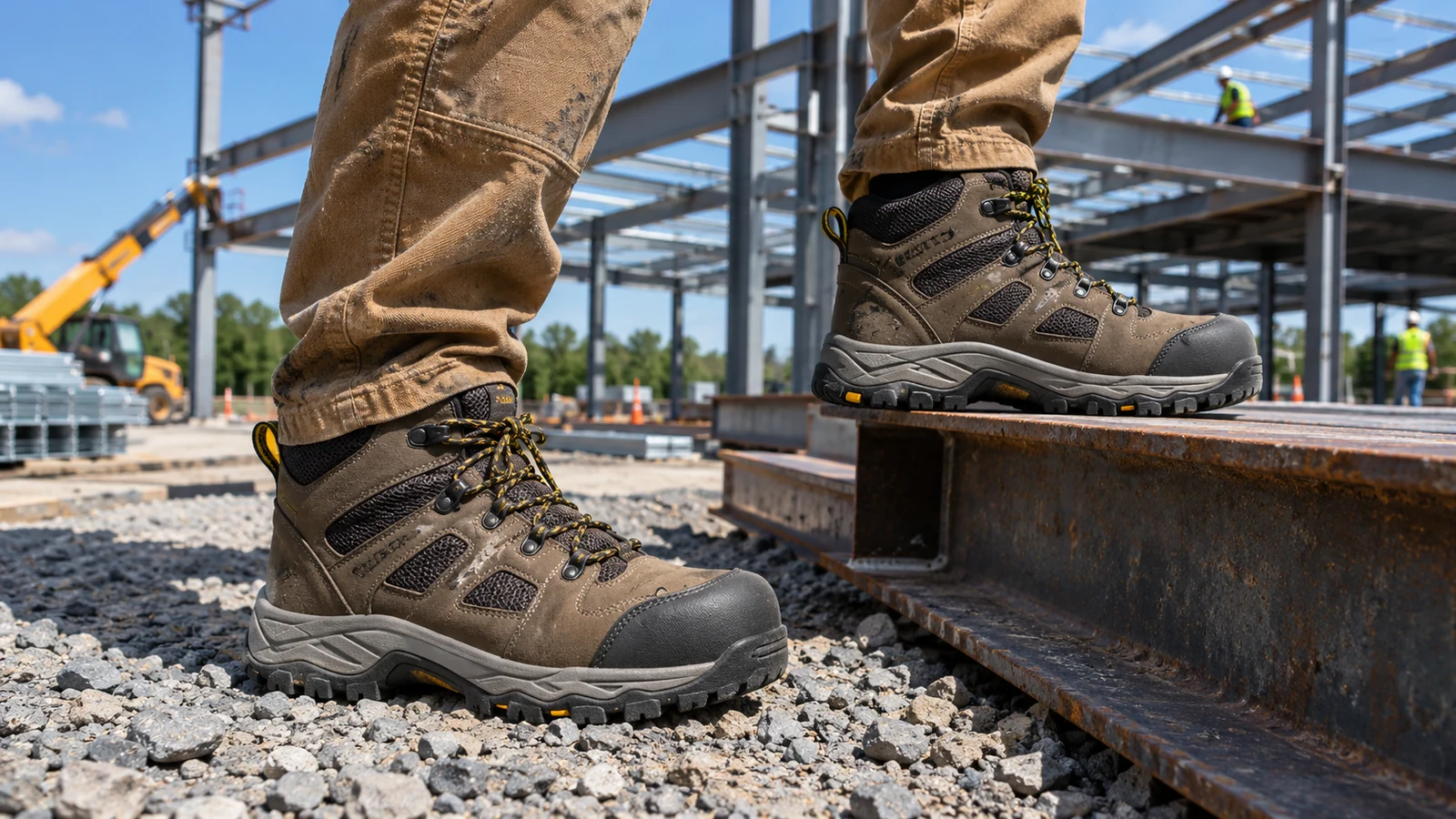
Best Hiker-Style Safety Boots in Canada: 4 Top Picks
Compare 4 CSA Grade 1 hiker-style safety boots in Canada for agility and comfort, evaluating toe caps, puncture plates, waterproofing, and slip resistance.
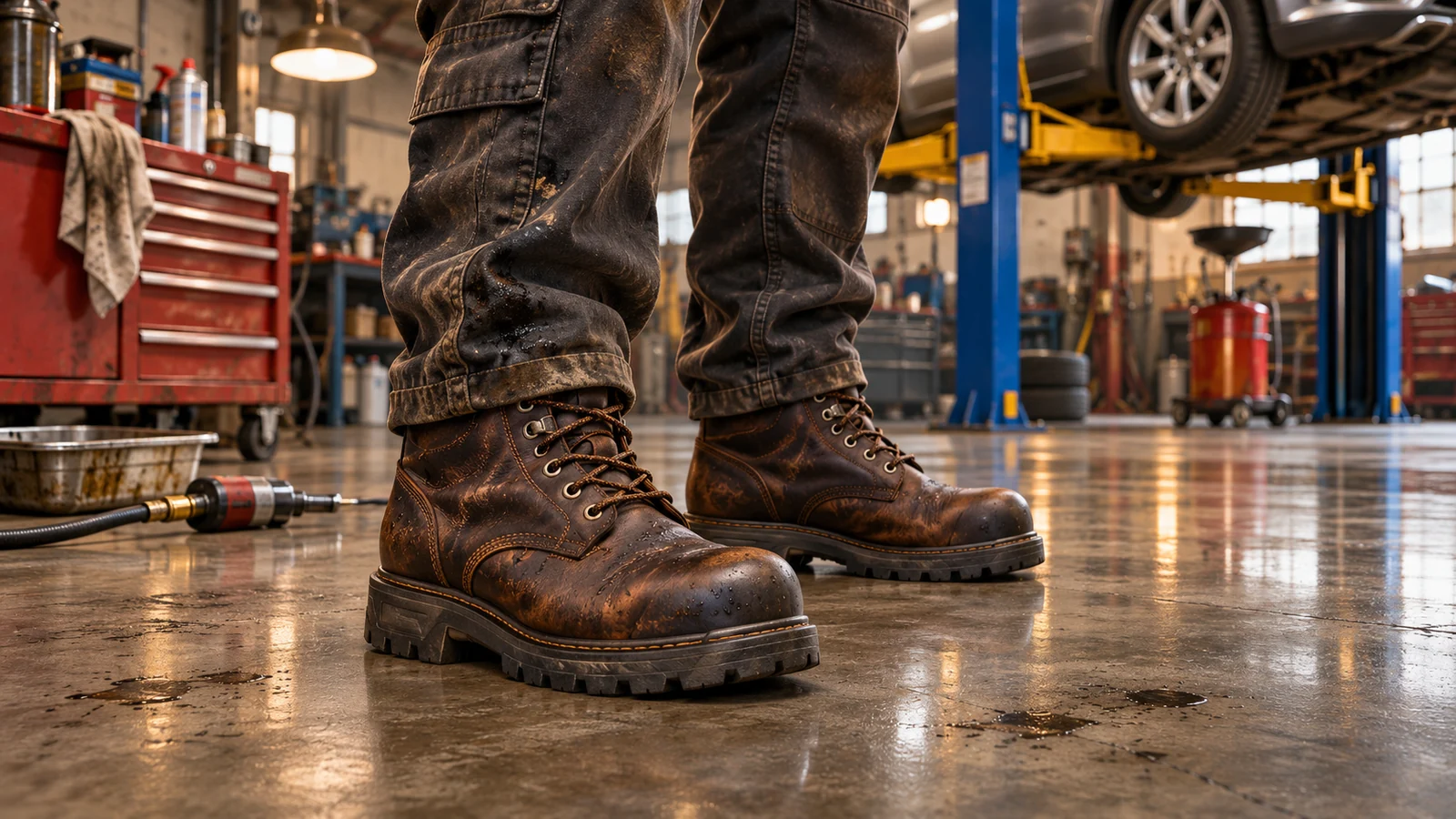
Best Work Boots for Mechanics: 5 Oil-Resistant CSA Picks
Work boots for mechanics compared: five CSA Grade 1 boots and shoes with listed oil- and slip-resistant outsoles, by toe type, ESR or SD, weight and upper.

How Should Safety Boots Fit? A CSA Boot Sizing Guide
How safety boots should fit: toe room, width, heel hold and when to measure, from CCOHS and brand fit guides, plus three CSA boots sold in many sizes and widths.