Pull-On vs. Lace-Up Safety Boots: Which is Best for You? (2026 Curation)
As an Amazon Associate, BetterPick Hub earns from qualifying purchases. Our picks are based on manufacturer specifications and buyer review patterns, not hands-on testing.
Pull-On vs. Lace-Up Safety Boots: A Real Job Site Breakdown
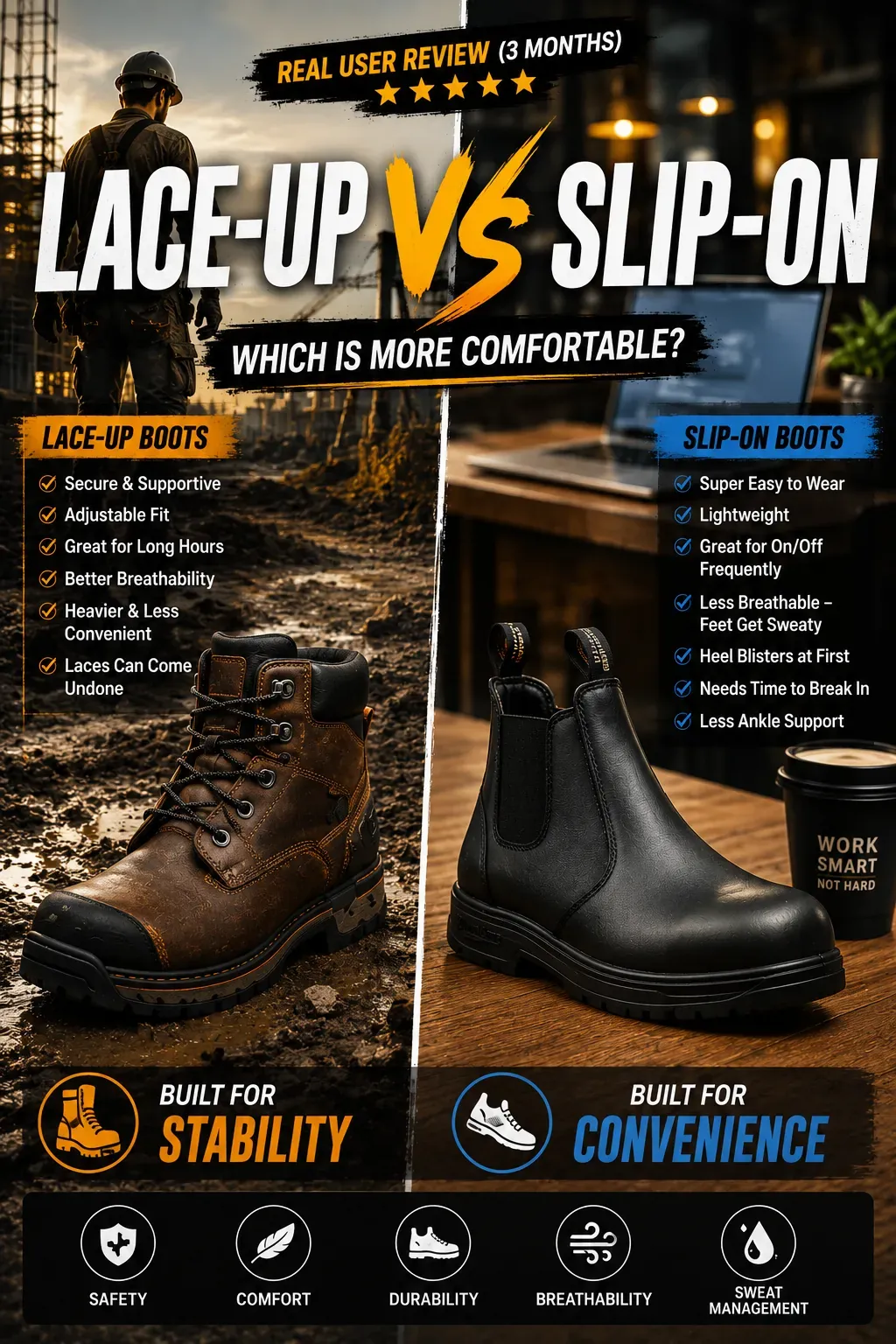
If you spend any time reading actual worker reviews on Reddit, job forums, or Amazon, one thing becomes crystal clear: people are deeply divided on safety boot type, and for very good reasons. Based on manufacturer specifications and patterns in worker reviews, here is what workers consistently report across both styles.
Lace-Up Boots (Timberland PRO Style): Real Worker Verdict
Pros from the field:
- Superior ankle and instep lockdown — the most commonly cited advantage. Workers doing long walks across uneven terrain, gravel, slopes, or scaffolding consistently prefer the customizable tightening of lace-ups.
- Less fatigue on long shifts — when the boot fits snugly around your arch and ankle, your foot doesn’t micro-shift inside the boot with every step, dramatically reducing joint and muscle fatigue by end-of-day.
- Adjustable fit — critical for workers with wide feet, high insteps, or ankle swelling throughout the shift.
- Better airflow — the lace channel creates natural ventilation pathways along the tongue, which slip-ons cannot replicate.
Cons from the field:
- Putting on and taking off takes time — a real friction point when entering/exiting clean areas dozens of times per shift.
- Boot weight is noticeably heavier.
- Laces can untie at inconvenient moments, and dirty laces are a constant nuisance.
Laceless Chelsea / Slip-On Boots (Blundstone, Tiger King Style): Real Worker Verdict
Pros from the field:
- The convenience factor is unmatched. Workers who move between outdoor job sites, site trailers, clean offices, and vehicles all day consistently say the ability to slip boots on and off in seconds is a complete game-changer.
- Lighter and more lifestyle-friendly — many workers wear their Chelsea safety boots during their commute and for errands, blurring the line between workwear and casualwear.
- Ideal for welders and fabricators — a smooth, laceless upper means zero exposed fabric for sparks, hot grease, or chemical splashes to catch on.
Cons from the field — the honest truth:
- Heel blisters in the first 1-2 weeks are extremely common. This is the single most frequently mentioned complaint in slip-on boot reviews. The rigid leather shaft rubs the back of the heel before the leather fully molds to your foot shape.
- The leather break-in period is real and takes patience.
- Instep pressure can develop if the elastic gore doesn’t align perfectly with your foot profile.
- Ventilation is noticeably weaker — during summer months especially, foot sweat becomes a significant comfort issue.
- Ankle lateral support is lower than a laced boot — not ideal for rocky or uneven terrain.
The Most Important Slip-On Break-In Tips (From Real Workers)
Two pieces of advice show up again and again in field reviews for Chelsea safety boots:
“First 1-2 weeks: wear thick socks, no exceptions.”
“Put heel blister tape or gel pads on the back of your heel before the leather softens.”
This pattern is universal across brands — from Blundstone to Tiger King. Once the leather fully conforms to your foot shape (typically after 10-15 full shifts), the boots become remarkably comfortable. At that point, many workers say they can never go back to lace-ups.
Hot Weather & Summer Tip: Sock Selection Matters
For workers in hot climates or during Canadian and Korean summers, the enclosed Chelsea upper traps heat significantly. Worker reviews frequently recommend this pairing:
- Merino wool socks (counterintuitively) are the top recommendation — they wick moisture rapidly and regulate temperature far better than cotton or synthetic socks.
- Sport performance socks with moisture-wicking zones are a solid budget-friendly alternative.
- The sock choice makes a noticeably larger comfort difference in slip-on boots than in lace-ups.
Quick Comparison
| Feature | Timberland PRO Men’s Pit Boss 6” Steel Toe Boot | Blundstone RotoFlex Metal Free Work & Safety Boot | Tiger King Jasper Men’s Premium CSA Approved Chelsea Safety Boots |
|---|---|---|---|
| Ankle Support | Maximum (Custom Tightening) | RotoFlex Cushion (Elastic Gore) | Composite Toe (Elastic Chelsea Gore) |
| Ease of Use | Lacing Required (Time-consuming) | Instant Slip-On / Kick-Off | Instant Slip-On / Kick-Off |
| Enclosed Protection | Moderate (Folds can collect dust/sparks) | Maximum (Completely smooth upper) | Maximum (No lace folds, EH protected) |
| Best For | Construction, Mud & Heavy Lifting | Welders, Heavy Industry & Long Shifts | Security, Factories & Metal Detector Zones |
Timberland PRO Men’s Pit Boss 6” Steel Toe Boot
Classic Lace-Up
The gold standard of classic lace-ups. Features customizable speed-hook laces, padded collar, and shock-absorbing suspension technology to reduce joint fatigue.
Check the current price on Amazon.ca
Blundstone RotoFlex Metal Free Work & Safety Boot
Slip-On King
Australian-engineered premium Chelsea safety boot featuring RotoFlex cushioning technology. 100% metal-free composite toe, slip-resistant outsole, and waterproof leather upper.
Check the current price on Amazon.ca
Tiger King Jasper Men’s Premium CSA Approved Chelsea Safety Boots
Premium Chelsea
Premium CSA Grade 1 composite toe Chelsea safety boot. 100% metal-free construction with Kevlar puncture protection and electrical hazard defense. Ideal for security checkpoints and indoor work.
Check the current price on Amazon.ca
Who Should Buy What
Choose Lace-Up Boots if:
- You walk long hours on uneven terrain, gravel, slopes, or scaffolding.
- Ankle stability and injury prevention are your top priority.
- You have wide feet or need a highly customized fit.
- You work in well-ventilated outdoor environments.
Choose Chelsea / Slip-On Boots if:
- You frequently move between indoor and outdoor areas and remove boots regularly.
- Convenience and daily wearability (including commute) are your priority.
- You work in welding, fabrication, painting, or other spark/spill-hazard environments where laces are a risk.
- You are willing to invest 1-2 weeks in a proper break-in period with thick socks and heel protection.
Related Curation Guides
To explore more specialized footwear and job site curations, check out: