Best CSA Rubber Safety Boots Canada: Slush, Mud and Cold
As an Amazon Associate, BetterPick Hub earns from qualifying purchases on Amazon.ca.
As an Amazon Associate, BetterPick Hub earns from qualifying purchases. Our picks are based on manufacturer specifications and buyer review patterns, not hands-on testing.
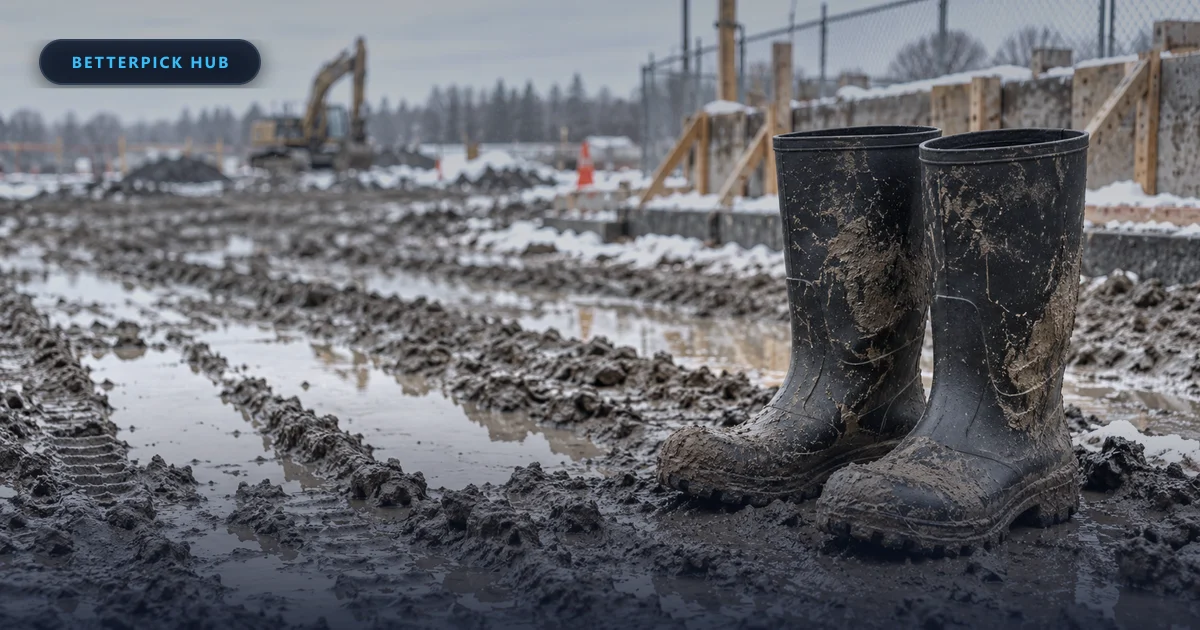
This guide is for people who work in slush, mud and standing water on Canadian sites and want a pull-on rubber-style safety boot instead of a leather boot. The quick answer: if you need a puncture plate and real cold protection, the BOGS Workman CSA has the lowest temperature rating listed here, and the Kamik Workday 3 BX is the steel toe and plate option with a -40°C liner and a snow collar. If you need a boot the maker lists as ESR/EH rated, look at the Baffin Hunter (Safety Toe & Plate). If you work in milder wet conditions and your site does not call for a puncture plate, look at the uninsulated Kamik Irongrid.
Kamik and Baffin describe the Workday 3 BX, Irongrid and Hunter as slip-on boots. If you are still deciding between pull-on and lace-up styles in general, our pull-on vs. lace-up safety boot guide covers that choice.
Quick Picks
- If you need the lowest listed cold rating with a composite toe and a puncture plate: BOGS Workman CSA (72132PP)
- If you need a steel toe and plate with a removable liner rated to -40°C: Kamik Workday 3 BX
- If you need a CSA/ASTM approved boot that the maker lists as ESR/EH rated: Baffin Hunter (Safety Toe & Plate)
- If you need an uninsulated steel toe boot for wet work where no puncture plate is required: Kamik Irongrid
- Who should not buy any of these: if your employer requires a specific CSA marking that a boot’s page does not list (for example the green triangle for puncture protection on the Irongrid, or an electrical rating on the BOGS), check the label on the boot itself or pick a different model. The Canadian Centre for Occupational Health and Safety (CCOHS) says to choose footwear according to the hazard and to select CSA-certified footwear with the proper rating for the hazard and the proper sole for the working conditions.
Quick Terms:
- CSA Z195: CCOHS points workers to CSA Standard Z195-14 (R2023) “Protective footwear” when choosing footwear by hazard.
- Green triangle: CCOHS says it means sole puncture protection with a Grade 1 protective toecap, for heavy industrial work, especially construction where sharp objects such as nails are present.
- Grey rectangle: a Grade 2 protective toecap with no puncture-resistant sole, for work environments that do not require puncture protection.
- ESR / Omega: CCOHS describes the white rectangle with an orange omega as electric-shock protective footwear, and warns that electrical shock resistance deteriorates with wear and in a wet environment. Your site’s electrical safety rules decide whether a boot like this is acceptable for your work.
Comparison Table
| Boot | Toe | Plate | Electrical rating listed | Liner / insulation | Cold rating listed | Height |
|---|---|---|---|---|---|---|
| BOGS Workman CSA (72132PP) | Composite (listed under Men’s Comp Toe Boots) | Puncture proof plate | Not listed | 5MM Neo-Tech + 2MM air mesh | -72°F/-60°C | 14” |
| Kamik Workday 3 BX | Steel | Puncture-resistant plate | No ESR/EH rating listed; Kamik says toe and plate provide resistance to electric shock | 6mm Thermal Guard removable liner | Comfort rating down to -40°C | 35 cm |
| Baffin Hunter (Safety Toe & Plate) | Steel | Steel plate | ESR/EH rated | Removable Tri-Fit multi-layer inner boot | Tundra Rated (-10°C to -30°C) | 13.75” |
| Kamik Irongrid | Steel (CSA Z195-14 Grade 2) | Not listed | EH (in CSA and ASTM codes) | None (N/A) | N/A | Not listed |
All four makers describe the boot as waterproof. Kamik and BOGS list CSA approval or CSA certification on their pages, and Baffin lists the Hunter as CSA/ASTM approved.
BOGS Workman CSA (72132PP)
Who it suits: people standing in slush or mud for long cold shifts who want a composite toe and the lowest temperature rating among these four boots.
Specs that matter: BOGS lists the Workman CSA under its men’s composite toe boots and describes it as “CSA approved” with a “Puncture proof plate.” The boot is “100% Waterproof” and made with seamless construction, which BOGS says makes it 30% lighter and more durable. Warmth comes from 5MM Neo-Tech waterproof insulation plus 2MM air mesh for temperature regulation, and BOGS gives it a temperature rating of -72°F/-60°C. It is 14” tall with a 17” calf circumference, which is worth checking if you tuck in heavy work pants. Underfoot there is a contoured EVA footbed with gel cushioning and a BioGrip slip resistant outsole. The page lists sizes 7 to 15.
What the page does not say: BOGS does not list an electrical (ESR or Omega) rating on this page. If your site requires one, confirm on the boot’s label before you buy.
What buyers say: the BOGS Canada page shows an average rating of 4.6 from 111 reviews. The review text was not available for us to summarize, so we cannot describe common praise or complaints for this model.
Kamik Workday 3 BX
Who it suits: people who want a steel toe and plate in a rubber boot with a removable liner, for winter yard, site or industrial work.
Specs that matter: Kamik calls the Workday 3 BX “CSA approved rubber boots” with a steel toe and puncture-resistant plate, and describes the steel toecap as CSA and ASTM-approved. The shell is 100% waterproof GROUND-CTRL Rubber, and an adjustable nylon collar is there to keep out snow, slush and rain. Inside is a 6mm Thermal Guard moisture-wicking removable liner with a comfort rating down to -40°C.
Kamik says the safety toe and plate provide resistance to electric shock, and lists the outsole as oil and acid resistant with deep treads. The boot is 35 cm tall and weighs 2180 g by pair, with a 40.5 cm circumference in size 9. It is made in Canada from domestic and imported materials, and the page lists sizes 7 to 13. One practical note: Kamik marks this item as final sale on its own website, so check the return policy wherever you buy.
What buyers say: Kamik’s page shows 4.2 from 5 reviews, which is a small sample. Most are short positives (excellent, great value, and one saying the boots are comfy and warm with no heel slip). One reviewer said their feet got cold at -20°C even though the tag gives a -40°C rating, which is a reminder that a liner rating is not a promise for every person or every level of activity.
Baffin Hunter (Safety Toe & Plate)
Who it suits: people who want a made-in-Canada pull-on boot that the maker lists as both CSA/ASTM approved and ESR/EH rated, with a removable multi-layer liner.
Specs that matter: Baffin lists a steel safety toe and plate, CSA/ASTM approval and an ESR/EH rating. The upper is a tall, lightweight and flexible thermoplastic elastomer (TPE) compound rather than natural rubber, with a nylon locking snow collar. Baffin rates its waterproofing as B-Tek Dry Waterproof, which it calls its highest level of waterproofing. The outsole is described as self-cleaning.
Warmth comes from a removable Tri-Fit multi-layer inner boot system. Baffin gives the Hunter its Tundra rating, which it describes as comfort during moderate to high activity where temperatures from -10°C to -30°C have been experienced. That is a milder range than the BOGS or Kamik Workday 3 BX ratings, so it suits active work more than standing still in deep cold. In men’s size 9 the boot is 13.75” tall with a pair weight of 6.21 lbs. Baffin lists recommended applications including agriculture, construction, manufacturing, food processing and utilities. Sizes on the page run from 6 to 14.
Fit: Baffin says the boot “Fits true to size. Half size? Size up.” It also says its boots may feel tight when first worn because the multi-layer inner boot’s insulation forms to your foot after wear, and suggests wearing them around the house first.
What buyers say: Baffin’s page shows 3.9 out of 5 from 12 reviews. One buyer praises the grip, the comfort and the tie top that keeps snow out, and another says it runs large. Two reviewers report the upper splitting or getting a hole after weeks or months of use. One buyer was unhappy with the attached warning that electrical shock resistance deteriorates in wet conditions. That warning matches what CCOHS says about electric-shock protective footwear, and it matters on a wet site.
Kamik Irongrid
Who it suits: people doing wet work in milder weather (wash-down, spring mud, fall rain) whose site needs a protective toe but not a puncture-resistant sole.
Specs that matter: Kamik lists the Irongrid’s certifications as CSA Z195-14 Grade 2 ST/EH and ASTM F2413-24 I/C/EH. It has a steel toe, and Kamik does not list a plate. Per CCOHS, a Grade 2 protective toecap with no puncture-resistant sole is the grey rectangle marking, meant for work environments that do not require puncture protection. If your site has nails or other sharp debris underfoot, CCOHS points to the green triangle (Grade 1 toe with puncture protection) instead, and the other three boots here list a plate.
The Irongrid shell is waterproof Ground-CTRL Rubber. There is no lining, no insulation and no temperature rating, so plan on warm socks if the weather turns. It has a moulded EVA insole, a slip-on closure and a non-marking outsole. Kamik lists a weight of 1837.05 g / 4.05 lbs for the men’s size 9 sample and a 40.64 cm / 16.0 in circumference. It is made in Canada.
What buyers say: there were no reviews on Kamik’s page when we checked, so there is no buyer pattern to report yet.
How to Choose a Rubber Safety Boot for Your Site
Start with the marking your job requires. CCOHS tells workers to choose footwear according to the hazard and to look for the proper CSA rating for that hazard. On construction sites with nails and sharp debris, that usually means the green triangle (Grade 1 toe with puncture protection). Three of these boots list a plate; the Irongrid does not. For a full walk-through of the symbols, see our CSA safety boot symbols guide.
Treat electrical ratings with care in wet work. CCOHS says electric shock resistance of footwear is greatly reduced by wet conditions and wear. Rubber boots are bought for wet sites, so if your job lists an electrical requirement, follow your employer’s electrical safety rules and check the marking on the boot rather than relying on the boot being rubber.
Match the cold rating to how much you move. The listed ratings here are measured in different ways. BOGS gives a single temperature rating (-72°F/-60°C), Kamik gives a liner comfort rating (down to -40°C), and Baffin’s Tundra rating describes comfort during moderate to high activity from -10°C to -30°C. If you stand still for long periods, lean toward the colder rating. If you are moving all day, a milder rating may be enough. For leather insulated boots instead of rubber, see our insulated winter work boot guide.
Steel or composite toe. The BOGS uses a composite toe, while the Kamik and Baffin boots use steel. Our steel toe vs. composite toe guide explains the trade-offs.
Get the fit right before the first shift. CCOHS suggests trying on new boots around midday, because feet normally swell during the day. It says boots should have ample toe room, with toes about 12.5 mm from the front, and that you should not expect footwear to stretch with wear. Try them on with the socks you usually wear at work. If you plan to add an insole, CCOHS says to check with the manufacturer whether adding inserts affects your level of protection. Pull-on rubber boots also have a fixed calf opening, so compare the listed calf or shaft circumference (17” on the BOGS, 40.5 cm on the Workday 3 BX in size 9) with your leg and pants.
Inspect them through the season. CCOHS recommends inspecting footwear regularly for damage such as cracks in soles or exposed toe caps, and repairing or replacing worn or defective footwear. It also says footwear exposed to sole penetration or impact may not show visible damage, so it is advisable to replace it after an event. Since Baffin Hunter reviewers mention a split and a hole in the upper, a quick look at the flex points at the end of each week is a good habit with any rubber boot.
Who Should Buy What
- Standing in slush on long, cold shifts and you want a composite toe: BOGS Workman CSA (72132PP)
- Winter yard or site work where you want a steel toe and plate with a removable -40°C liner: Kamik Workday 3 BX
- Your employer wants a boot listed as ESR/EH rated, and you are active in moderate cold: Baffin Hunter (Safety Toe & Plate)
- Wet work in milder weather with no puncture hazard, and you do not need insulation: Kamik Irongrid
- Not sure which marking you need: check our CSA safety boot symbols guide and ask your supervisor before you buy.
Sources & Technical References
Related Safety Boots Guides
Black Friday Work Boots: A Spec Checklist Before You Buy
A practical spec checklist for Black Friday work boot shopping in Canada, covering CSA certification labels, toe materials, width sizing, and return policies.
Best Lightweight CSA Work Boots in Canada: Ranked by Weight
Discover the best lightweight CSA work boots in Canada ranked by published grams per shoe, comparing composite toes, flexible plates, and all-day comfort.
Best Side-Zip Work Boots in Canada: 4 Top Picks
Compare 4 top CSA-certified side-zip work boots in Canada for fast on-and-off convenience, evaluating zipper durability, safety toe caps, and ankle support.