Best Insoles for Work Boots on Concrete Floors
As an Amazon Associate, BetterPick Hub earns from qualifying purchases on Amazon.ca.
As an Amazon Associate, BetterPick Hub earns from qualifying purchases. Our picks are based on manufacturer specifications and buyer review patterns, not hands-on testing.
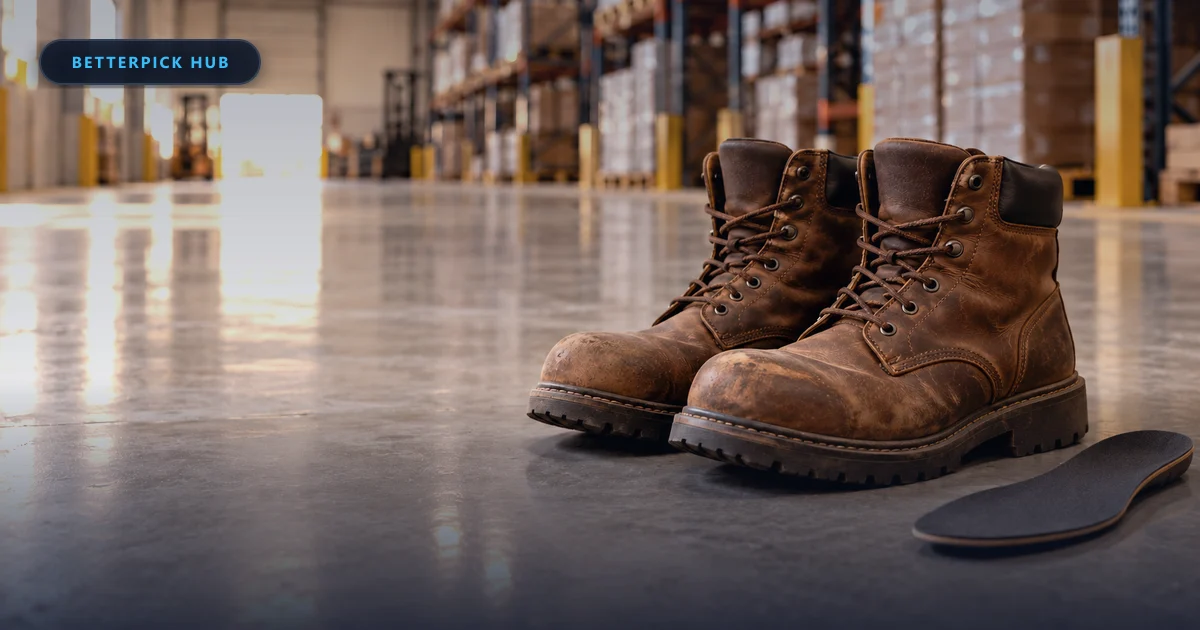
This guide is for people who spend their shift standing or walking on concrete in work boots and want to swap the flat factory liner for something better. The short answer: match the insole’s thickness to how much room your boot has, and match the arch to your foot. For most roomy work boots and safety toe boots, start with the Superfeet Work Cushion, which Superfeet lists for work boots and safety toe footwear. If your boots or safety shoes are snug, go thinner with the Superfeet Work Slim-Fit Cushion.
Before anything else, one safety point. The Canadian Centre for Occupational Health and Safety (CCOHS) says to “check with the manufacturer if adding inserts affects your level of protection.” That matters most if your boots carry a special rating, so read the section on rated boots below before you buy.
Quick Picks
- If you need a Max-thickness, soft-cushion insole for a roomy work boot or safety toe boot: Superfeet Work Cushion
- If you need an insole for slim-fitting work boots or athletic-style safety shoes: Superfeet Work Slim-Fit Cushion
- If you need a firm, high arch in a roomy boot: Superfeet All-Purpose Support High Arch (formerly Green)
- If you need a gel-cushion work insole with separate men’s and women’s sizes: Dr. Scholl’s Work Insoles with Massaging Gel
- If you need firm arch support with no trimming that moves between pairs of footwear: PowerStep Maxx Support Insoles (Pinnacle Maxx)
- Who should not buy any of these yet: anyone whose boots carry a special rating, such as static-dissipative (SD), until they have checked with the boot maker whether an insert affects that protection. Also skip a thick insole if your boot is already snug at the toes.
Comparison Table
| Insole | Arch height | Thickness | Cushioning | Fits best in | Trim-to-fit | Sizes |
|---|---|---|---|---|---|---|
| Superfeet Work Cushion | All | Max | Soft | Work boots, roomy work shoes, safety toe footwear | Yes | Men 5.5 to 15, Women 6.5 to 14 |
| Superfeet Work Slim-Fit Cushion | All | Mid | Soft | Moderate to tight fitting work footwear with removable insoles | Yes | Men 5.5 to 13, Women 6.5 to 14 |
| Superfeet All-Purpose Support High Arch | High | Max | Firm | Roomy to moderate fitting footwear with removable insoles | Yes | See maker’s size chart |
| Dr. Scholl’s Work Insoles with Massaging Gel | Supportive arch | Not listed | Responsive-Wave Cushioning, Extended Massaging Gel | Work boots and shoes, casual shoes and sneakers | Yes | Men’s 8-14, Women’s 6-10 |
| PowerStep Maxx (Pinnacle Maxx) | Firm polypropylene shell | Not listed | Foam top layer, EVA base | Footwear where the factory insoles can be removed | No | Men’s 3 to 16+, Women’s 5 to 12 |
Quick Terms: “Arch height: All” is how Superfeet labels an insole it lists for every arch height. “Thickness” here is the maker’s own label (Mid or Max), not a measurement. “Trim-to-fit” means you cut the insole down to your boot size.
Superfeet Work Cushion
Who it suits: People who wear roomier work boots or safety toe footwear and want a Max-thickness insole with soft cushioning.
Superfeet lists the Work Cushion as best for “work, standing/walking long hours,” and says it fits best in “Work Boots, Roomy Work Shoes, Safety Toe Footwear.” It is rated Max thickness with Soft cushioning, and Superfeet lists it for all arch heights.
The detail that matters most in a safety boot is the front end. Superfeet says the Work Cushion has a tapered forefoot that “improves fit in work & safety toe footwear.” The company’s work-line article describes this as a forefoot that tapers under the toes. That is relevant because the toe cap in a safety boot does not stretch, so any extra bulk under your toes takes up space you cannot get back.
Other published features:
- It replaces the removable liner in roomy work footwear. Superfeet’s own words are that it “can replace the flat, unsupportive removable liner” that came with the boots.
- Adaptive Comfort Technology, which Superfeet describes as patented support that flexes with the foot.
- A Moisturewick top cover that helps reduce odours, made from 100% recycled material.
- Trim-to-fit. Superfeet says to size half a size up if you are between sizes or unsure, and to trim so there is a 1 to 2 mm gap at the end of the shoe.
Superfeet does not list a heel cup or a foam type on this product page.
What buyers say: On the Superfeet product page, reviewers often praise the cushioning for standing on concrete through long shifts and the way it fits across different work shoes and boots. The complaints are mixed: one reviewer wanted more padding at the heel and toe, one described it as rigid, and one reported uneven insoles and a popping sound after trimming.
Because it is Max thickness, this is the one to skip if your boots are already close-fitting.
Superfeet Work Slim-Fit Cushion
Who it suits: People in slim-fitting work boots or athletic-style safety shoes, where a thick insole would crowd the foot.
Superfeet describes it as offering “lightly structured, durable support in a slim profile.” It is listed as best for “slim-fitting work boots, athletic-style work shoes” and fits best in “moderate to tight fitting work footwear with removable insoles.” Superfeet says it is “ideal for tighter fitting and/or athletic inspired work footwear.”
Key specs:
- Arch height: All
- Thickness: Mid
- Cushioning: Soft
- Tapered forefoot that improves fit in work and safety toe footwear
- Moisturewick top cover made from 100% recycled material
- Trim-to-fit, with the same advice: half a size up if between sizes, and a 1 to 2 mm gap at the end of the shoe
- Sizes: Men 5.5 to 13, Women 6.5 to 14
What buyers say: Reviewers on the Superfeet page praise comfort over long shifts, the arch support and the fit in boots, and some say it fit without trimming. On the other side, some felt the slim profile gave less cushion than they expected.
Superfeet All-Purpose Support High Arch (formerly Green)
Who it suits: People with high arches who wear roomier boots and want firm structure rather than soft cushioning.
This is not part of Superfeet’s work line, but Superfeet lists “work footwear” among its uses, alongside everyday shoes, walking and running. It was previously named GREEN, which is useful to know if you are searching older listings.
Key specs from Superfeet:
- Arch height: High
- Thickness: Max
- Cushioning: Firm
- Fits best in: roomy to moderate fitting footwear with removable insoles
- Durable high density foam that supports the whole foot, with a stabilizer cap that “provides structure & support”
- Sculpted heel cup that encapsulates and positions the heel
- Moisturewick top cover that helps reduce odours
- Trim-to-fit, with half a size up suggested if you are between sizes
In the Q&A on its product page, Superfeet says the insole accommodates “up to an EE in width.” The same Q&A says returns or exchanges are available within 60 days of purchase, even if the insoles have been trimmed and worn.
What buyers say: Reviewers mention using it in work and hunting boots. They also note that it takes up more space than typical insoles, so it suits higher-volume shoes or boots.
Pick this over the Work Cushion if you want firm support under a high arch more than soft cushioning, and your boot has the room.
Dr. Scholl’s Work Insoles with Massaging Gel
Who it suits: People who want a gel-cushion insole made for work boots and shoes, and who like separate men’s and women’s sizing.
Dr. Scholl’s says it designed these insoles for “people who work on their feet all day.” The product page lists them for both “Work Boots & Shoes” and “Casual Shoes & Sneakers.”
Published features:
- Responsive-Wave Cushioning
- A supportive arch that Dr. Scholl’s says “helps to evenly distribute weight”
- Extended Massaging Gel cushioning
- Polygiene StayFresh Technology for odour control
- Sizes: Men’s 8-14 and Women’s 6-10
Dr. Scholl’s does not list the materials or the thickness, so you cannot compare its bulk with the Superfeet models on paper. Our table shows “Not listed” for that reason.
The fitting instructions are simple. Take out the current insoles, put the new ones in to test the size, and if needed trim along the printed outline near the toes that matches your shoe size.
We did not find a buyer review summary from a source we could cite, so we have left that out rather than guess.
PowerStep Maxx Support Insoles (Pinnacle Maxx)
Who it suits: People who want a firm arch support, do not want to trim anything, and may move the insole between their work boots and other footwear.
PowerStep describes the Maxx as having its signature arch shape “but with a firmer shell and an angled heel platform.” It is also called the Pinnacle Maxx.
Key specs:
- A firm but flexible polypropylene support shell with a 2 degree medial post (the angled part under the inner heel)
- A deep heel cradle
- Foam top layer, EVA base and an odour-control polyester top fabric
- Full length, with no trimming required, and moveable from shoe to shoe
- Intended for footwear where the factory insoles can be removed; PowerStep’s FAQ names work boots, walking shoes and casual sneakers
- Fits widths up to 2E; PowerStep’s Q&A points people needing 3E to 6E to the Pinnacle Wide
- Sizes: Men’s 3 to 16+ and Women’s 5 to 12
PowerStep’s FAQ says most users adapt within 1 to 3 days, and that the firmer support may take slightly longer than the standard Pinnacle. Its Q&A says the insoles should last 6 months or longer under normal wear.
What buyers say: Reviewers on the PowerStep page praise the fit without trimming, the support, and how easily it moves between pairs of footwear. Complaints include some finding it too rigid, one reviewer saying it raised their foot too high to fit their sneakers, and one finding the arch less stiff than other PowerStep models.
How to Fit an Insole in a Safety Boot
An insole that fits in a running shoe can still be wrong for a safety boot. Here is how to decide, using what the boot and insole makers publish.
1. Protect your toe room first. CCOHS says boots “should have ample toe room (toes should be about 12.5 mm from the front).” It also says, “Do not expect footwear to stretch with wear.” A thicker insole lifts your foot inside the boot. In a safety boot, the toe cap is fixed, so if your toes already touch the front or top of the cap, a Max-thickness insole is the wrong choice. Look at a Mid-thickness or slim model instead, such as the Superfeet Work Slim-Fit Cushion. For background on toe caps, see our guide to steel toe vs. composite toe safety boots.
2. Take the factory liner out. Superfeet lists the Work Cushion as replacing the removable liner in roomy work footwear, and PowerStep says the Maxx is intended for footwear where the factory insoles can be removed. Stacking two insoles uses up toe room fast.
3. Trim carefully, a little at a time. For the Superfeet models, the company says to trim to your shoe size and leave a 1 to 2 mm gap at the end of the shoe. Dr. Scholl’s prints an outline near the toes for each size. A simple approach is to lay your old factory liner on top as a template. The PowerStep Maxx is the exception: PowerStep lists it as full length with no trimming required.
4. Check the heel and ankle after the swap. CCOHS says boots “should fit snugly around the heel and ankle when laced.” An insole changes how your foot sits, so lace the boots fully and walk around. CCOHS also advises you to “walk in new footwear to ensure it is comfortable.” If you are choosing between boot styles, our pull-on vs. lace-up safety boots guide covers how each one adjusts.
5. Buying new boots? Bring the insole. CCOHS says to “make allowances for extra socks or special arch supports when buying boots,” to “try on new boots around midday” because feet normally swell during the day, and to “try on your new boots with the supports or socks you usually wear at work.” If you know you will run a Max-thickness insole, try boots on with it in place. Our roundup of the best work boots for Canadian job sites is a good place to start.
If your boots carry a special rating
Some safety boots carry markings beyond toe and sole protection. For example, CCOHS says a yellow rectangle with black SD letters “indicates static-dissipative footwear.” Our CSA safety boot symbols guide explains the full set of labels.
None of the insole makers in this guide say how their insoles interact with these ratings. CCOHS’s advice is to “check with the manufacturer if adding inserts affects your level of protection.” So if your boots have a special rating, contact the boot maker before swapping the insole, and follow your employer’s footwear rules.
Winter adds another wrinkle. If you switch to insulated boots and thicker socks for the cold months, the room inside the boot changes too. Our guide to insulated winter work boots covers those boots.
Who Should Buy What
- Workers in roomy work boots or safety toe boots who want a Max-thickness, soft-cushion insole: Superfeet Work Cushion
- Workers in slim boots or athletic-style safety shoes: Superfeet Work Slim-Fit Cushion
- People with high arches in roomy boots who prefer firm support: Superfeet All-Purpose Support High Arch (formerly Green)
- Anyone who wants a gel-cushion work insole with separate women’s sizing: Dr. Scholl’s Work Insoles with Massaging Gel
- People who want firm arch support, no trimming, and widths up to 2E: PowerStep Maxx Support Insoles (Pinnacle Maxx)
- Anyone in boots with a special rating such as SD: check with your boot maker before adding any insert, then choose from the list above.
Sources & Technical References
Related Safety Boots Guides
Best Hiker-Style Safety Boots in Canada: 4 Top Picks
Compare 4 CSA Grade 1 hiker-style safety boots in Canada for agility and comfort, evaluating toe caps, puncture plates, waterproofing, and slip resistance.
Best Work Boots for Mechanics: 5 Oil-Resistant CSA Picks
Work boots for mechanics compared: five CSA Grade 1 boots and shoes with listed oil- and slip-resistant outsoles, by toe type, ESR or SD, weight and upper.

How Should Safety Boots Fit? A CSA Boot Sizing Guide
How safety boots should fit: toe room, width, heel hold and when to measure, from CCOHS and brand fit guides, plus three CSA boots sold in many sizes and widths.