Best Ice Cleats for Work Boots: 4 Picks for Canadian Winter
As an Amazon Associate, BetterPick Hub earns from qualifying purchases on Amazon.ca.
As an Amazon Associate, BetterPick Hub earns from qualifying purchases. Our picks are based on manufacturer specifications and buyer review patterns, not hands-on testing.
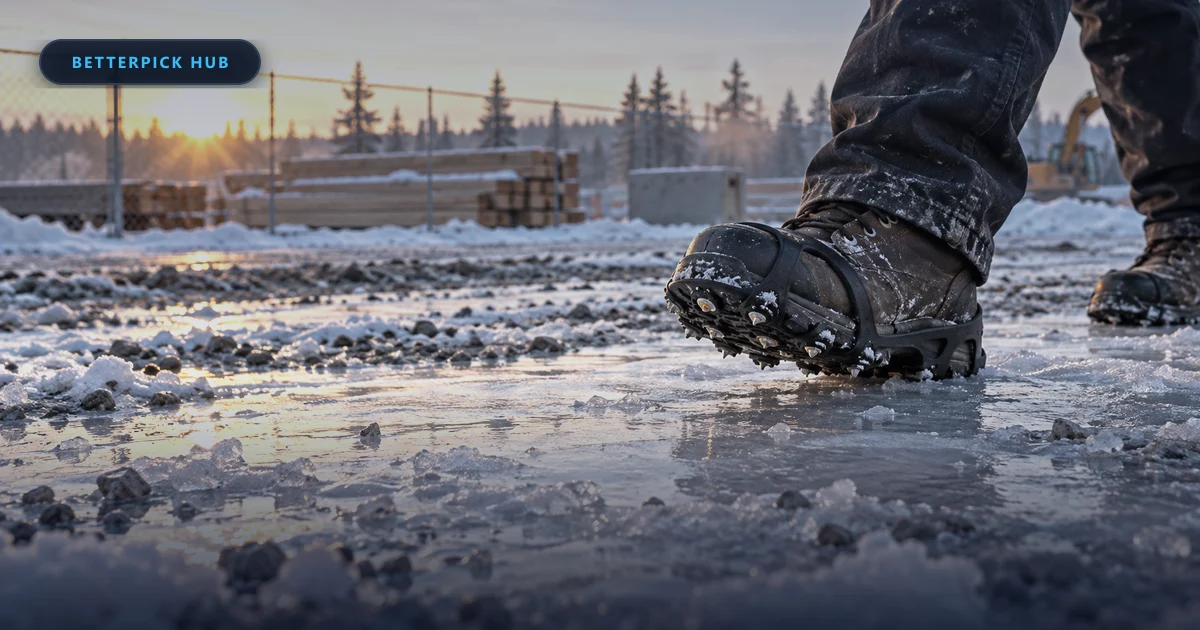
This guide is for Canadian workers who spend winter shifts outside on ice and packed snow: yard crews, road and construction workers, delivery drivers on foot, and anyone crossing an icy lot to get to the job. The quick answer: if you work outside for long stretches on ice and snow, look first at a studded cleat with replaceable studs, such as the STABIL Maxx 2 or the Ergodyne TREX 6310. If your day mixes ice, slush and bare pavement, the Yaktrax Diamond Grip lists all of those terrains. The Yaktrax Pro is a coil design whose terrain field on the maker’s page names packed snow, pavement, mixed conditions and slush.
One rule applies to almost every pick here: these are outdoor tools. The Government of Alberta’s winter slips bulletin says it is important to remove cleats when entering a building, because they can cause a slip.
Nobody at BetterPick Hub has worn these cleats. This is a curation of what the manufacturers publish, plus a few Canadian workplace safety sources. We could not open enough buyer review pages to describe reliable review patterns, so this guide leaves review patterns out rather than guess.
Choosing the boots to wear with your cleats? Our work boots for snow removal crews in Canada guide compares options for plow operators and on-foot crews.
Quick Picks
- If you need replaceable studs and the coldest stated rating in this group: STABIL Maxx 2 (STABILicers Maxx 2)
- If you need a full-sole studded cleat for construction or road work that stays on all shift: Ergodyne TREX 6310 Adjustable Slip-On Ice Cleats
- If you need one cleat for ice, slush, packed snow and pavement: Yaktrax Diamond Grip Traction Device
- If you need a coil design for packed snow and slush on the walk in: Yaktrax Pro Traction Device
- Who should not buy any of these: if your job has you walking in and out of buildings or climbing in and out of a vehicle all day, removable cleats need to come off each time you go indoors or drive. A flip-style cleat that stays on the boot, or footwear with slip-resistant soles, may suit that day better.
Comparison Table
| Cleat | Traction type | Stud or edge count | Replaceable studs | Stated cold rating | Listed terrain or use |
|---|---|---|---|---|---|
| STABIL Maxx 2 | Heat-treated cleats in a TPE sole | 15 cleats | Yes (threaded receptacles) | Flexible to -45 degrees F | Outdoor work in snow and ice |
| Ergodyne TREX 6310 | Heat-treated carbon steel studs | 10 studs per cleat | #6301 studs sold separately (retailer listing) | Rated to -40 degrees F | Outdoors, ice, slush, snow |
| Yaktrax Diamond Grip | Case-hardened steel alloy beads | “Hundreds of biting edges” | Not listed | Sub-zero (no number listed) | Packed snow, ice, slush, mixed, pavement |
| Yaktrax Pro | 1.4 mm steel coils | Not listed | Not listed | Breakage tested to -41 degrees F | Packed snow, pavement, mixed, slush |
Weight was not listed on any of the four manufacturer pages we used, so it is left out of the table.
How to Read Ice Cleat Specs
Stud type. There are three designs in this guide. Studded cleats (Maxx 2, TREX 6310) put heat-treated cleats or studs under the sole. Bead cleats (Diamond Grip) use steel beads on cables, with many small edges. Coil cleats (Yaktrax Pro) wrap steel coils around the sole.
Stud count. More studs is not automatically better, but it tells you how the traction is spread. Ergodyne says the TREX 6310’s 10 studs line the foot, with a thicker tread connecting the mid-foot and heel stud zones. STABIL puts 15 cleats into the Maxx 2 sole.
Replaceable studs. On a work cleat that sees concrete, gravel and steel every day, studs wear. Replaceable studs let you keep the body and swap the points. Only STABIL states this clearly on its own page.
Cold rating. Each maker words this differently, so read it literally. STABIL says the Maxx 2 is tested to remain flexible to -45 degrees F. Ergodyne says the TREX 6310 is rated to negative forty degrees Fahrenheit and won’t break in cold temperatures. Yaktrax says the Pro is tested safe from breakage as low as -41 degrees F. For the Diamond Grip, Yaktrax only says the rubber sling remains elastic and secure in sub-zero temperatures. These ratings are about the cleat’s materials holding up in cold. None of them is a promise about grip at that temperature.
STABIL Maxx 2 (STABILicers Maxx 2)
Who it suits: workers who spend most of the shift outdoors on snow and ice and want to replace worn studs instead of the whole cleat. STABIL (an Implus brand) describes the Maxx 2 as “a robust traction device ideal for outdoor work in snow and ice.”
Specs that matter:
- 15 heat-treated cleats built into a lightweight TPE compound sole.
- Replaceable cleats. STABIL’s STS (Stabil Traction System) uses threaded cleat receptacles, which it describes as easily interchangeable and replaceable.
- Cold rating: tested to remain flexible to -45 degrees F, the lowest stated figure among the four picks here.
- Straps: polyester hook-and-loop straps that STABIL says stay connected even when wet.
- Oil resistant, according to the manufacturer page.
- Weight: STABIL says it is 24% lighter than the original Stabil Maxx. A weight figure is not listed.
Sizing: STABIL lists sizes from Women’s 6.5-8 / Men’s 5-6 up to Men’s 14.5-16, including Men’s 8-10, Men’s 10.5-12 and Men’s 12.5-14.
Outside view: in a Consumer Reports test reported by 6abc in January 2016, the original Stabilicers Maxx performed best by far of four slip-on devices on ice. That test used the earlier Maxx, not the Maxx 2, so treat it as background on the design, not a result for this exact model.
What buyers say: we could not access enough buyer reviews to report a pattern for this cleat.
Ergodyne TREX 6310 Adjustable Slip-On Ice Cleats
Who it suits: construction and road crews who put cleats on at the start of an outdoor shift and leave them on. Ergodyne recommends the TREX 6310 for construction, road work, and applications with little or no transitioning from vehicles or buildings. Read that last part closely. If you are in and out of a truck all day, this is not the cleat Ergodyne has in mind.
Specs that matter:
- 10 heat-treated carbon steel studs line the foot, with a thicker under-sole tread connecting the mid-foot and heel stud zones. Ergodyne lists the traction coverage as full sole.
- Fit: a one-piece stretch design hugs the toe and heel, and an adjustable cord cinches tight. Large thumb tabs on the heels help with getting them on and off.
- Recommended conditions: outdoors, ice, slush and snow.
- Cold rating: Ergodyne’s page says it is temperature rated to negative forty degrees Fahrenheit and won’t break in cold temperatures.
- Replaceable studs: Ergodyne’s own spec page does not mention this. A retailer listing (Full Source) says #6301 replacement studs are sold separately. Check that the replacement studs are available to you before counting on them.
Sizing: Ergodyne gives a work-boot size chart, which is useful because cleats sized for sneakers can be tight over a bulky boot. For men’s work boots: M fits 5-7.5, L fits 8-10.5 and XL fits 11-13. For women’s work boots: M fits 7-9.5, L fits 10-12 and XL fits 13-15. Ergodyne notes this is approximate sizing and footwear may vary.
What buyers say: we could not access enough buyer reviews to report a pattern for this cleat.
Yaktrax Diamond Grip Traction Device
Who it suits: people whose route mixes ice, slush, packed snow and bare pavement, such as a walk from the parking lot across a partly salted yard.
Specs that matter:
- Diamond Beads with case-hardened steel alloy edges. Yaktrax says they give “hundreds of biting edges” but does not list an exact count.
- Swiveling beads. The beads swivel independently, which Yaktrax says keeps snow and ice from building up.
- Materials: aircraft-grade steel cable, steel chains and eyelets with zinc coating, and a natural rubber sling.
- Listed terrain: packed snow, ice, slush, mixed conditions and pavement.
- Cold: Yaktrax says the rubber sling remains elastic and secure in sub-zero temperatures. No numeric rating is listed.
- Replaceable beads: not listed.
Sizing: Yaktrax lists shoe-size ranges of Women’s 6-7 / Men’s 5-6, Women’s 7.5-10 / Men’s 6.5-9, Women’s 10.5-13.5 / Men’s 9.5-12.5, Women’s 14+ / Men’s 13+, and Women’s 14++ / Men’s 13++. Yaktrax’s size chart note says insulated boots add two shoe sizes. That matters if you are pulling these over a winter work boot; see our guide to insulated winter work boots for how bulky those boots can be.
Warranty: Yaktrax says Implus will replace defective parts within 90 days, and the warranty applies to use as a traction aid on outdoor ice and packed snow.
What buyers say: we could not access enough buyer reviews to report a pattern for this cleat.
Yaktrax Pro Traction Device
Who it suits: people who mostly face packed snow and slush, for example on the walk in to the site, and want a coil design instead of studs. Be clear on its limits before you buy it for ice.
Specs that matter:
- Coils: 1.4 mm high strength, abrasion resistant steel coils containing 70% recycled content. Yaktrax describes “360 degrees of traction.”
- Fit: a natural rubber foot frame with a removable over-foot strap.
- Cold: tested safe from breakage in temperatures as low as -41 degrees F.
- Listed terrain: packed snow, pavement, mixed conditions and slush.
- Replaceable coils: not listed.
Outside view: in the same 2016 Consumer Reports test reported by 6abc, the Yaktrax Pro performed worst of the four devices at the rink. The tester also said all of the devices improve traction on ice, but there were big differences in performance. If bare ice is your main problem, weigh that before choosing the Pro.
Sizing: Yaktrax lists shoe-size ranges of Women’s 6.5-10 / Men’s 5-8.5, Women’s 10.5-12.5 / Men’s 9-11, Women’s 13-15 / Men’s 11.5-13.5, and Women’s 15.5+ / Men’s 14+. For oversized shoes or boots, Yaktrax recommends buying one size larger than your normal shoe size.
What buyers say: we could not access enough buyer reviews to report a pattern for this cleat.
Choosing and Using Ice Cleats on the Job
Take them off indoors. This is the most important point in the whole guide. The Government of Alberta says it is important to remove cleats when entering a building, as they can cause a slip. The BC Forest Safety Council says removable crampon-style and economical cleats suit workers who spend a considerable amount of time outside on slippery surfaces, as long as they are removed when you go indoors or drive a vehicle. WorkSafeNB also suggests changing into indoor footwear and cleaning your shoes when you go inside.
Match the cleat to how often you go in and out. If you stay outside most of the shift, a removable studded cleat like the Maxx 2 or TREX 6310 fits what the BC Forest Safety Council describes. If you are in and out of a vehicle or building many times a day, the BC Forest Safety Council notes that flip-style cleats stay on your boots and are flipped up when not needed, and suit travel to and from your vehicle and mobile equipment operators. None of the four picks here is a flip-style cleat.
Match the cleat to the surface. Read each maker’s terrain list. Ergodyne lists ice, slush and snow for the TREX 6310.
Size for the boot, not your shoe. Cleats go over your footwear, and work boots are bigger than sneakers. Ergodyne publishes a separate work-boot column in its size chart. Yaktrax says to add two sizes for insulated boots on the Diamond Grip, and to go one size up for oversized shoes or boots on the Pro. If you are between sizes and wearing a bulky insulated boot, those instructions point toward the larger size.
Cleats are an add-on, not a replacement for good boots. CCOHS notes that there is no footwear with anti-slip properties for every condition. The Alberta bulletin recommends winter footwear with good traction for working and walking to work, and WorkSafeNB says ice grippers that attach to your footwear can provide additional traction. Start with the right boot for your job; our guide to work boots for Canadian job sites and our explainer on CSA safety boot symbols cover that side. Then add cleats for the icy part of the day.
Check your studs. On cleats with replaceable studs, look at the studs regularly and swap out worn ones using the maker’s parts. On designs where replacement parts are not listed, expect to replace the whole cleat when the traction parts wear.
Who Should Buy What
- Outdoor crew working on ice and snow all shift, wanting replaceable studs: STABIL Maxx 2.
- Construction or road worker who stays outside with little going in and out: Ergodyne TREX 6310.
- Worker crossing a mix of ice, slush and bare pavement: Yaktrax Diamond Grip.
- Someone walking in on packed snow and slush, not bare ice: Yaktrax Pro.
- Anyone moving in and out of buildings or vehicles all day: look at a flip-style cleat or slip-resistant footwear instead of a removable cleat.
Sources & Technical References
- Stabil Maxx 2 (Implus)
- Ergodyne TREX 6310 Adjustable Slip-On Ice Cleats
- Full Source: Ergodyne Trex 6310 Adjustable Ice Traction Device
- Yaktrax Diamond Grip Traction Device
- Yaktrax Pro Traction Device
- 6abc: Consumer Reports - Get a grip on slippery ice with slip-on cleats (2016)
- Government of Alberta: Don't slip into winter - Hazards and controls
- BC Forest Safety Council Crew Talk: Winter Slips, Trips & Falls
- WorkSafeNB: Winter safety - Prevent slips, trips and falls
- CCOHS OSH Answers: Slips, Trips and Falls
Related Safety Boots Guides
Black Friday Work Boots: A Spec Checklist Before You Buy
A practical spec checklist for Black Friday work boot shopping in Canada, covering CSA certification labels, toe materials, width sizing, and return policies.
Best Lightweight CSA Work Boots in Canada: Ranked by Weight
Discover the best lightweight CSA work boots in Canada ranked by published grams per shoe, comparing composite toes, flexible plates, and all-day comfort.
Best Side-Zip Work Boots in Canada: 4 Top Picks
Compare 4 top CSA-certified side-zip work boots in Canada for fast on-and-off convenience, evaluating zipper durability, safety toe caps, and ankle support.