Best Boot Dryer for Wet Work Boots: Convection vs Fan
As an Amazon Associate, BetterPick Hub earns from qualifying purchases on Amazon.ca.
As an Amazon Associate, BetterPick Hub earns from qualifying purchases. Our picks are based on manufacturer specifications and buyer review patterns, not hands-on testing.
This guide is for anyone who pulls off wet work boots at the end of a shift and needs them dry before the next one: roofers and framers after a day of rain, yard workers coming in from slush, and anyone whose boot liners never quite dry out by morning.
The quick answer: if your boots sit overnight, a silent convection dryer like the Original PEET is the simple choice, and the PEET Multi does the same job for two pairs. If you need boots dry in a few hours, or you want a no-heat option and a timer, look at a fan dryer such as the DryGuy Force Dry DX or the PEET Advantage Plus. Before you add heat to leather boots, read what your boot maker says about drying, because some makers tell you to dry at room temperature.
Nobody at BetterPick Hub has used these dryers. The picks below come from the makers’ published specs and the patterns in Amazon.ca buyer reviews.
Quick Picks
- If you need silent overnight drying for your work boots: The Original PEET Shoe & Boot Dryer
- If you need to dry two pairs, or boots and gloves, overnight: The Original PEET Multi Shoe & Glove Dryer
- If you need faster drying with a heat or no-heat choice: Advantage Plus PEET Dryer
- If you need a timer and tall-boot tubes in the box: DryGuy Force Dry DX
- Who should skip all of these: if your boot maker’s care guide says to dry only at room temperature, follow it. Of these four, only the Force Dry DX and the Advantage Plus list a no-heat setting.
Comparison Table
| Dryer | Drying method | Pairs at once | Tall boots | Heat / no heat | Timer | Wattage | Warranty |
|---|---|---|---|---|---|---|---|
| Original PEET | Thermal convection, no fan | Not listed | 12-inch extensions needed over 11 inches (sold separately) | Not listed | Not listed | 36 W | 25 years |
| PEET Multi | Thermal convection, no fan | 2 pairs, or 1 pair plus gloves | 12-inch extensions attach to any PEET upright dryer | Not listed | Not listed | 72 W | 25 years |
| PEET Advantage Plus | Fan | 2 pairs | Not listed | Heat or no heat | Not listed | 220 W on heat | 5 years |
| DryGuy Force Dry DX | Forced air (rotary blower) | 2 pairs | Tubes included for boots up to 16 inches | Heat or no heat; heats to 105°F (40.5°C) | 3 hours | Not listed | 1 year |
Wattage figures are the makers’ 120-volt ratings. “Not listed” means the maker’s product page does not give that spec.
Convection vs. Fan: The One Choice That Matters
Boot dryers come in two basic types, and the type decides most of what you will notice day to day.
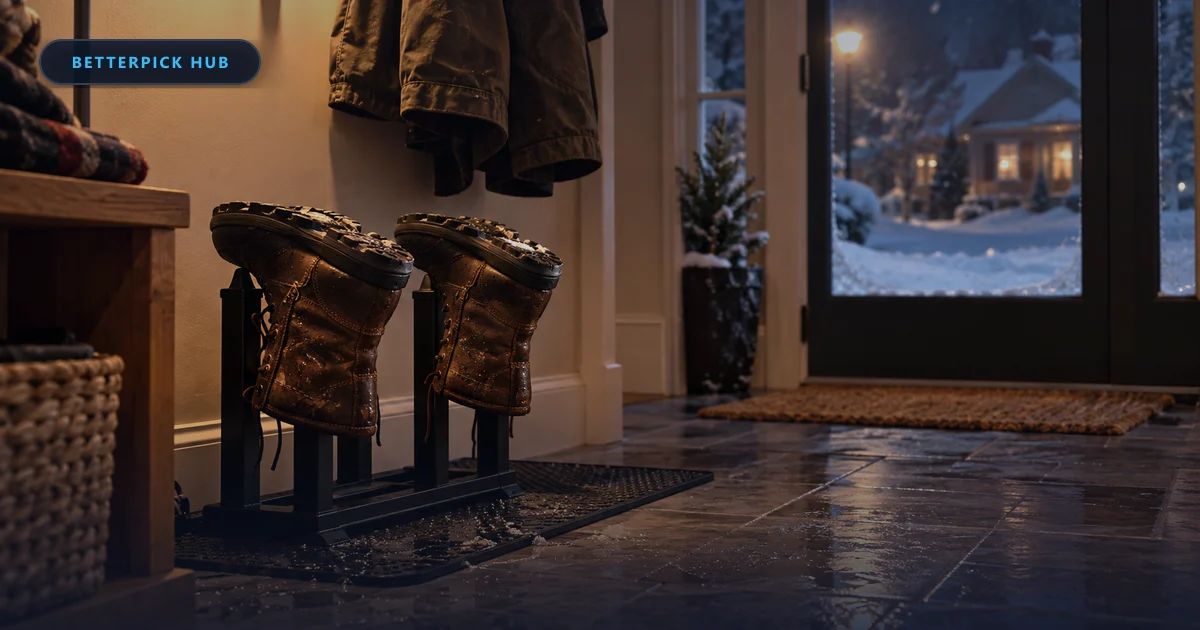
Convection dryers (the PEET Original and Multi) have no fan. PEET describes the method as slightly warmed air that rises through its AirChambers and DryPorts. PEET says these can stay plugged in 24 hours a day, 7 days a week, and recommends leaving footwear on overnight for best results. They are quiet, but they are not fast.
Fan and forced-air dryers (the PEET Advantage Plus and DryGuy Force Dry DX) push air through the boot. PEET says the Advantage Plus dries footwear faster than its traditional thermal convection models, and lists 1 to 4 hours of drying time. DryGuy lists 1 to 2 hours for two pairs on the Force Dry DX. Both have a heat or no-heat setting.
If your boots come off at 5 p.m. and go back on at 6 a.m., a convection dryer has the whole night to work. If you work split shifts or need boots dry between a morning and an afternoon job, the faster fan models fit better.
The Original PEET Shoe & Boot Dryer
Who it suits: someone with one set of work boots who takes them off at night and wants a dryer they can leave plugged in all the time.
Specs that matter:
- Drying method: thermal convection with no fan. PEET’s page says “No loud fans blowing hot air.”
- Always-on use: PEET says it can stay plugged in 24/7.
- Drying time: PEET says it depends on material and saturation, and recommends leaving footwear on overnight.
- Power: 36 watts at 120 volts (0.3 amps).
- Tall boots: PEET says 12-inch extensions are required for boots taller than 11 inches. They are sold as a pair, and one pair covers tall boots or hip waders.
- Size: 2.5 lbs, 9.5 by 9.5 inches, 22 inches tall.
- Warranty: 25 years, if you register within 10 days of purchase.
- Materials: PEET lists leather, rubber, vinyl, neoprene, canvas, synthetics, fleece and microfiber as safe to use on the dryer.
The page does not list a heat setting, a timer or a pair count, so check those on the listing before you buy if they matter to you.
What buyers say: on Amazon.ca the Original PEET has 4.5 out of 5 stars from 15,261 ratings. Amazon’s AI summary of customer reviews says buyers find it dries boots well and runs silently. It says the heat output keeps shoes warm, though some buyers note next to no heat comes out. Buyers like the odour reduction and find it easy to use. Opinions are mixed on value for money and durability.
If your work boots stand taller than 11 inches, budget for the extensions. PEET also sells an XL Tall version that includes one pair of 12-inch extensions you can remove for standard-height footwear, and PEET describes it as ideal for knee boots and hip boots.
The Original PEET Multi Shoe & Glove Dryer
Who it suits: a household with two people in work boots, or one worker who wants to dry boots and gloves together overnight.
Specs that matter:
- Capacity: PEET says the base handles 2 pairs of footwear, or 1 pair of footwear and 1 pair of gloves.
- In the box: 4 footwear DryPorts and 2 glove DryPorts.
- Drying method: the same no-fan thermal convection as the Original. PEET says it can be left plugged in 24/7 and recommends leaving footwear and gloves on overnight.
- Power: 72 watts at 120 volts (0.6 amps).
- Size: 5 lbs, 9 by 13.25 inches, 25 inches tall.
- Warranty: 25 years, with registration within 10 days.
- Tall boots: PEET’s 12-inch extensions attach to any PEET upright dryer and are meant for footwear taller than 11 inches.
What buyers say: on Amazon.ca the PEET Multi has 4.7 out of 5 stars from 396 ratings. Amazon’s AI summary of customer reviews says it works well and runs quietly. Buyers appreciate that it dries overnight, and some find the slow drying process better. The heat output gets positive feedback. Opinions are mixed on value for money and the attachments.
The trade-off against the Original is simple: twice the ports and twice the wattage (72 W against 36 W), with the same overnight drying approach.
Advantage Plus PEET Dryer
Who it suits: someone who wants PEET’s upright design but needs boots dry in hours, not overnight, and wants to choose between heat and no heat.
Specs that matter:
- Drying method: a fan pushes air through the Air Chambers and DryPorts. PEET calls the fan whisper-quiet and says it is ETL-approved.
- Heat: you choose heat or no heat.
- Drying time: PEET lists 1 to 4 hours, depending on materials and how wet the footwear is.
- Capacity: PEET says the base handles 2 pairs of footwear.
- Power: 120 volts, 220 watts on the heat setting.
- Size: 5.25 lbs, 8.5 by 13.5 inches, 18.5 inches tall.
- Warranty: 5 years, shorter than the 25 years PEET gives its convection models.
- Materials: PEET lists leather, rubber, vinyl, neoprene, canvas, synthetics, fleece, felt and microfiber.
What buyers say: on Amazon.ca the Advantage Plus has 4.3 out of 5 stars from 337 ratings. Amazon’s AI summary of customer reviews says it works well and is easy to use. Some users are disappointed with the airflow. Opinions vary on heat control, value for money and durability.
The no-heat setting is the main reason to pick this over the Multi if you own leather boots and want to follow a room-temperature drying rule (see the section on heat below).
DryGuy Force Dry DX
Who it suits: someone who wants the most control: a timer, a heat or no-heat switch, and tubes for tall boots included.
Specs that matter:
- Drying method: forced air from a rotary blower that DryGuy calls whisper-quiet.
- Capacity: DryGuy says it dries two pairs of boots, shoes or gloves, and works on four garments at once.
- Drying time: DryGuy lists 1 to 2 hours.
- Heat: a heat or no-heat switch. On heat, DryGuy says it heats to 105°F (40.5°C).
- Timer: 3 hours.
- Tall boots: two removable extension tubes are included, for boots up to 16 inches tall.
- Size: 15.08 by 7.6 by 12.44 inches.
- Warranty: 1 year.
- Wattage: not listed on DryGuy’s product page.
What buyers say: on Amazon.ca the Force Dry DX has 4.5 out of 5 stars from 11,373 ratings. Amazon’s AI summary of customer reviews says it dries boots and wet soccer cleats in about 1.5 hours. Buyers call it compact, though some find it larger than expected. They appreciate its portability and odour control. Buyers dislike the airflow, and opinions are mixed on the timer, value for money and noise level.
The included tubes for boots up to 16 inches tall and the 3-hour timer listed by DryGuy are the main reasons to choose it over the PEET models.
Heat and Leather: Check Your Boot Maker First
Dryer makers and boot makers do not always say the same thing.
On the dryer side, PEET lists leather among the materials its dryers are safe to use on. DryGuy says the Force Dry DX will not shrink, warp or otherwise harm delicate garments and custom fit liners.
On the boot side, Red Wing’s care guide says to always let boots air dry at room temperature and to avoid direct heat sources like radiators or hair dryers, which it says can dry out the leather. Red Wing’s boot care FAQ says never to dry its boots near a radiator, heater or direct sunlight, and that intense heat dries leather too fast, causing it to crack, stiffen and lose its natural oils. It recommends drying at room temperature, ideally with cedar boot trees inside to help the boots hold their shape. Neither Red Wing page mentions boot dryers either way.
What this means for buying:
- Find your boot maker’s care instructions before you pick a dryer, especially for full-grain leather work boots.
- If your maker says room temperature only, a dryer with a no-heat setting (Force Dry DX or Advantage Plus) lets you move air through the boot without adding heat.
- If your boots are rubber or synthetic, PEET lists those materials as safe to use on its dryers.
For leather insulated boots in particular, the insulated winter work boots guide covers the boots themselves, and the boot maker’s own care page is the place to confirm how they should be dried.
Matching the Dryer to Your Boots and Your Schedule
A few practical checks before you order:
Measure your boot height. PEET’s extensions are for footwear taller than 11 inches. DryGuy’s tubes cover boots up to 16 inches. If your boots are taller than that, the dryer’s maker page is the place to confirm fit.
Count the pairs. The PEET Multi, the Advantage Plus and the Force Dry DX each list two pairs. If two people in your home wear work boots, or you rotate two pairs, a single-port setup means someone waits.
Think about when the boots come off. PEET recommends overnight drying for its convection models. If you need dry boots in a few hours, the makers of the two fan models list 1 to 4 hours (Advantage Plus) and 1 to 2 hours (Force Dry DX).
Think about noise and power. The convection PEETs have no fan at all and draw 36 W (Original) or 72 W (Multi). The fan models are described as whisper-quiet by their makers, but Force Dry DX buyers are mixed on noise level, and the Advantage Plus draws 220 W on heat.
Look at the warranty. The PEET convection models carry 25 years with registration, the Advantage Plus 5 years and the Force Dry DX 1 year.
If you are still choosing the boots that go on the dryer, our guide to work boots for Canadian job sites compares CSA-rated boots on toe cap, sole protection and waterproofing.
Quick Takeaway: Convection (PEET Original, PEET Multi) means silent and overnight. Fan or forced air (PEET Advantage Plus, DryGuy Force Dry DX) means faster drying with a no-heat option. Check your boot maker’s care guide before using heat on leather.
Who Should Buy What
- One pair of work boots, dried overnight: The Original PEET Shoe & Boot Dryer.
- Two pairs, or boots plus gloves, dried overnight: The Original PEET Multi Shoe & Glove Dryer.
- Leather boots and a boot maker that says room temperature only: Advantage Plus PEET Dryer or DryGuy Force Dry DX on the no-heat setting.
- Faster turnaround between shifts: DryGuy Force Dry DX (1 to 2 hours listed) or Advantage Plus PEET Dryer (1 to 4 hours listed).
- Tall rubber or pull-on boots up to 16 inches: DryGuy Force Dry DX, which includes extension tubes.
- Knee or hip boots on a PEET: the Original PEET XL Tall, or any PEET upright dryer with the 12-inch extensions.
Sources & Technical References
- The Original PEET Shoe & Boot Dryer
- The Original PEET Multi Shoe & Glove Dryer
- Advantage Plus PEET Dryer
- PEET 12-inch DryPorts extensions for tall boots and waders
- The Original PEET XL Tall Shoe & Boot Dryer
- DryGuy Force Dry DX
- PEET Original Dryer on Amazon.ca
- PEET Multi 4 Electric Dryer on Amazon.ca
- PEET Advantage Plus Boot Dryer on Amazon.ca
- DryGuy DX Forced Air Boot Dryer on Amazon.ca
- How to Properly Care for Your Red Wing Boots
- Red Wing Boot Care FAQ
Related Safety Boots Guides
Best Hiker-Style Safety Boots in Canada: 4 Top Picks
Compare 4 CSA Grade 1 hiker-style safety boots in Canada for agility and comfort, evaluating toe caps, puncture plates, waterproofing, and slip resistance.
Best Work Boots for Mechanics: 5 Oil-Resistant CSA Picks
Work boots for mechanics compared: five CSA Grade 1 boots and shoes with listed oil- and slip-resistant outsoles, by toe type, ESR or SD, weight and upper.
How Should Safety Boots Fit? A CSA Boot Sizing Guide
How safety boots should fit: toe room, width, heel hold and when to measure, from CCOHS and brand fit guides, plus three CSA boots sold in many sizes and widths.